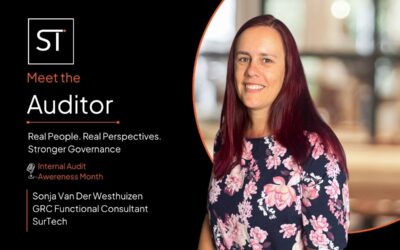


The future of internal audit changes every day.
Today’s auditors are expected to understand technology, interpret data, communicate with executives, and help organisations navigate increasingly complex risks — all while keeping governance practical and business-focused.
Meet the Auditor: Bruce Kotsi

For this edition of our “Meet the Auditor” series, we spoke to Bruce Kotsi about how technology and AI are reshaping the profession, why strong relationships still matter in audit, and what modern governance looks like in practice.
What inspired you to pursue a career in internal auditing?
My interest in auditing started with technology.
While studying for a BSc in IT, I became fascinated by how technology could accelerate a business or expose it to major vulnerabilities. That perspective deepened during my time at PwC South Africa in IT audit, where I realised that internal audit is not just about identifying issues — it’s about helping organisations navigate risk with greater clarity.
What continues to motivate me today is the profession’s evolution.
I’m particularly passionate about helping organisations move away from reactive auditing and toward more real-time, data-driven assurance. Governance technology and analytics are changing the way businesses approach risk, and audit now sits at the centre of that transformation.
What skills are most important for modern auditors?
Modern auditors need a combination of technical knowledge, business understanding, and people skills.
Data and technology literacy have become essential. Auditors need to understand analytics, automation, and GRC systems to effectively assess modern business environments.
At the same time, strong business acumen is equally important. Auditors need to understand strategic objectives and explain why risks and controls matter to the broader business.
And finally – communication.
You can produce excellent analysis, but if you cannot translate findings into practical business insight, the message gets lost.
What’s one thing AI will never replace in audit?
Professional scepticism and contextual judgment.
AI can identify patterns and anomalies quickly, but it cannot understand nuance, intent, or organisational culture as people do.
Bruce explains that audit still relies heavily on human interaction, relationship-building, and the ability to understand the “why” behind the data.
What’s a green flag that tells you an organisation takes governance seriously?
When leadership treats governance as a strategic driver rather than a compliance exercise.
Organisations with mature governance environments typically demonstrate strong leadership accountability and invest in connected GRC systems rather than relying on fragmented spreadsheets and manual processes.
How is technology or AI changing internal audit?
Technology is moving internal audit from reactive reporting toward continuous assurance.
Instead of reviewing small samples, auditors can now assess entire data populations, identify anomalies in real time, and automate repetitive processes.
At the same time, organisations are introducing new risks through AI adoption, which means internal audit also plays an increasingly important role in overseeing governance around emerging technologies.
As Internal Audit Awareness Month continues, professionals like Bruce highlight how modern audit is becoming more connected, technology-enabled, and strategically aligned to business resilience.
At SurTech, we’re proud to support organisations across South Africa as they modernise governance, risk, and assurance practices.